An Introduction to Me
My name is Nicholas Ule, I have a Ph.D. in astronomy from New Mexico State University and here I'd like to explain what my dissertation was all about. My thesis is titled: "Quantifying Differential Rotation Across the Main Sequence". I was exploring this concept in order to be better understand the rotation and activity cycles of other stars besides our Sun. Differential rotation is just a fancy way of saying that a star's equator rotates faster than its poles do, it is also linked to production of magnetic fields but I didn't go into that too much. Ulitmately my work was significant in four ways:
- Measured differential rotation on 8 stars in one research project, most astronomers only do one at a time.
- Established a strong link between a star's mean rotation and the strength of differential rotation.
- Developed existing methods of studying stellar rotation, principally with the model I developed and the types of observations I took.
- Discovered new ways of using these methods to push modeling to a new level.
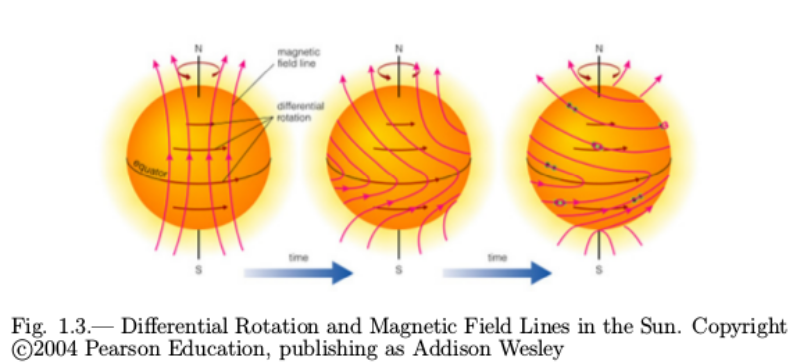
I have also included a small cartoon to help illustrate the effects of differential rotation and how this plays with activity levels on a star (typically see as spots and flares). A star's magnetic field is bound to its surface, therefore as the star rotates the magentic field lines rotate as well. Since a star with differential rotation will have different rotation rates between the equator and poles this means the field lines become tangled. This in turn is what causes a star to produce spots (cool and dark regions on a star) and flares (eruptions of material and light). My earliest studies of astronomy centered on flares and spots and naturally I was curious about their creation which is why my thesis is about differential rotation.